Here’s one that might be of use to us in the rebuilding efforts post-Ondoy and Pepeng: Katrina Practicum (Spring 2006), a course offered by the Urban Studies and Planning department.
Course description says:
In the wake of Katrina the entire gulf coast is embroiled in a struggle over what constitutes “appropriate” rebuilding and redevelopment efforts. This practicum will engage students in a set of work groups designed to assist local community based institutions and people in shaping the policy and practices that will guide the redevelopment and rebuilding efforts in the city of New Orleans.
View lecture notes, course syllabus, and other materials here.
Video above shows the 3-minute trailer. Watch the full film here.
In 200,000 years on Earth, humanity has upset the balance of the planet, established by nearly four billion years of evolution. The price to pay is high, but it’s too late to be a pessimist: humanity has barely ten years to reverse the trend, become aware of the full extent of its spoliation of the Earth’s riches and change its patterns of consumption.
“Home” is a quiet documentary on the state of the Earth, with aerial shots of mountains, forests, cities, farmlands filmed by French photographer Yann Arthus-Bertrand. Beautiful vistas, worth a look even for just the visual treat. It has been translated into 20 languages and was released simultaneously in cinemas, on television, on DVD and on Internet in over 50 countries around the globe on June 5th 2009 the World Environment Day. The English version is narrated by Glenn Close.
I hailed this movie to family and friends as “life-changing”. Sat through it twice in one weekend (first time alone, the second with my parents), only to sit through it again the following weekend to make sure my brothers watched it until the end (the last few minutes are critical!). I’ve given copies to friends and our office staff–and I will keep urging people to watch it until the message comes across: Our earth is dying. We can’t sit idly and worry about our own concerns anymore. Each of our spheres of influence has gotten wider–whether by our choice or not–and to maintain that climate change is a hoax or that it won’t affect us is to lie to ourselves.
The film is a tribute to our earth–it’s non-alarmist and doesn’t end with doomsday themes to make us paralyzed with depression or fear. It gives us hope, but does so with urgency: we must do our part.
Director Arthus-Bertrand insists that the movie remain free, and his team has created so much material for educators to use with it. Wrote more about the project in have you seen “home”?
This new report from the United Nation Environment Progamme says the impacts of climate change are coming faster and sooner, making it all the more urgent for governments to address climate change issues NOW.
…the newly emerging science points to some events thought likely to occur in longer-term time horizons, as already happening or set to happen far sooner than had previously been thought.
Pressing concerns include “ocean acidification linked with the absorption of carbon dioxide in seawater and the impact on shellfish and coral reefs” (happening decades earlier than existing models predict, and melting glaciers, ice-sheets and the Polar Regions (example: the Greenland ice sheet is melting 60 percent higher than the previous record of 1998), which can cause sea levels to rise by up to two metres by 2100 and five to ten times that over following centuries. The report says “thresholds or tipping points may now be reached in a matter of years or a few decades including dramatic changes to the Indian sub-continent’s monsoon, the Sahara and West Africa monsoons, and climate systems affecting a critical ecosystem like the Amazon rainforest.”
Damaging and irreversible impacts as a result of the greenhouse gases already in the atmosphere include:
– Losses of tropical and temperate mountain glaciers affecting perhaps 20 percent to 25 percent of the human population in terms of drinking water, irrigation and hydro-power.
– Shifts in the hydrological cycle resulting in the disappearance of regional climates with related losses of ecosystems, species and the spread of drylands northwards and southwards away from the equator.
The good news is there is hope:
Recent science suggests that it may still be possible to avoid the most catastrophic impacts of climate change. However, this will only happen if there is immediate, cohesive and decisive action to both cut emissions and assist vulnerable countries adapt.
United Nations Secretary-General, Ban Ki-moon, says: “This Climate Change Science Compendium is a wake-up call. The time for hesitation is over. We need the world to realize, once and for all, that the time to act is now and we must work together to address this monumental challenge. This is the moral challenge of our generation.”
Global environmental expert Nicky Perlas recently appeared on ANC to talk about Climate Change and Typhoon Ondoy. He confirmed one thing most of us already knew to be true but hoped against: that Super Typhoon Ondoy is just the first of many. Global warming is upon us, and now is not the time to be in self-denial and dillydally.
What can we do?
Here’s a great suggestion from Roy Cabonegro, Sec-Gen of the Partido Kalikasan Metro Manila:
Each of us has communities. Many of these were affected by the flooding. The flooding is both induced by climate change and because of our lack of preparedness as communities for necessary adaptation measures for more of this that is now inevitable due to the ill effects of climate change and our bad governance. In each of our barangays, town/cities, province and region, as we become more organized and link together, citizens must claim our right for appropriate immediate and long term plans, programs and actions for climate change adaptation. Such adaptation measures must be specific to each community and sufficiently financed. Let us do that now. Let us involve ourselves in direct governance now! Those who live in Paranaque, Las Pinas, City of Manila, Pateros, Taguig, Pasig, Makati, Caloocan, Malabon, Navotas, Valenzuela, Quezon City, Marikina, Antipolo, Tanay, San Mateo, Montalban– we are mobilizing local PK MM chapters in these areas now to engage our LGUs (barangay up) to work on this. We need to work together on this. Contact us (roy@partidokalikasan.org) Thanks Roy Cabonegro Sec-Gen, Partido Kalikasan Metro Manila
Amazing that while transcribing videos of Nicanor Perlas (global environmentalist and 2010 Presidential aspirant), I came upon one video that had him talking exactly about SMALL FARMER PRODUCTIVITY.
This was just a few days after I chanced upon an article by Jeffrey Sachs in which he says that the world’s top 8 countries (the G8) agreed to give $20B to help small farmers increase productivity. Seems like a normal aid activity, but Sachs stresses that this “is a potentially historic breakthrough in the fight against hunger and extreme poverty,” adding that combined with other initiatives, it “could be the greatest step so far toward achieving the Millennium Development Goals… to reduce extreme poverty, disease, and hunger by half by 2015.”
Empowering small farmers to solve world hunger and poverty. Such a simple idea. Could this be it? A real answer that is doable NOW?
How does this translate locally in any case?
Nicky Perlas in the video below briefly shares real, applicable solutions to agricultural productivity that have come from 40 years of working with farmers. He studied, lived, and breathed agriculture–it is his great love. And the best part is he presents them as a man who’s actually running for the highest office of the land. Imagine having a president who understands, and one who understands really, and from the ground (he experienced it, still experiences it), that to help is to empower.
Nicky Perlas is the real deal. And this vision of empowering everyone, of including everyone is seen in every aspect of his candidacy– from his platform, to his dialogues with individuals and groups (from the grassroots to the national and even the global levels), and even to his manner of relating to his volunteers. His slogan says it all–Tayong lahat Perlas. The solution is in empowering EVERYONE.
Email me or visit nicanorperlas.com if you’d like to help empower others, and in the process empower yourself!
* * *
Watch all videos of Nicky Perlas during the Mindanao forum held in Davao City last August 27, 2009 here. I included transcriptions of each video/issue for easier viewing. Issues discussed as follows:
1. Six Pillars of his Platform 2. Leadership for Mindanao 3. Economic Development and the Environment 4. Farm Land Conversion and Low Agricultural Productivity 5. Agriculture and Food Security 6. Philippine Education 7. Not Being Corrupt When Elected into Office 8. Indigenous Peoples Act of 1997 9. Indigenous Peoples Education 10. Business Investments in Mindanao 11. Future of the Youth in Mindanao 12. Bangsamoro Juridical Entity 13. Laws to Protect the Environment 14. Three Women’s Rights to Protect and Promote 15. On Another Woman to Become President 16. Peace Agreement with the MILF
A few weeks ago I watched a five-part BBC docu , How Art Shaped the World, which traced the roots of major themes of our modern lives—fascination with the female nude, death, exaggerated beauty—to traditions of the past that found expression in pottery, sculpture, images.
Found myself wondering why these ancient greats– Mesopotamia, Spain, Mexico, Portugal, Egypt– fell short of their promise and have become economic laggards today.. Is it a necessary to go up only to go down again? Egypt, for example, scaled the heights of power and conquest, and now, they’re among the world’s poorest. My mom went there in 2008 and went home saying the cars on the streets of Cairo were jalopies, worse than in Manila.
Jon told me to read Jeffrey Sachs’s “The End of Poverty” to understand why the rich countries are rich, and the poor countries poor. Great especially for non-economists. And it has a foreword by Bono.
Have yet to get a copy of that book, but today I came across Jeffrey Sachs in goodplanet.info, where he makes a case for small farmers and why aid should focus on them: “The G-8’s $20 billion initiative on smallholder agriculture, launched at the group’s recent summit in L’Aquila, Italy, is a potentially historic breakthrough in the fight against hunger and extreme poverty,” adding that combined with other initiatives, it “could be the greatest step so far toward achieving the Millennium Development Goals… to reduce extreme poverty, disease, and hunger by half by 2015.”
Sachs defines “smallholder farmers” as peasant families that work on farms one hectare (10,000 sqm or 2.5 acres) or less in size. To put that into context, Serendra in the Fort is 12.5 hectares in size, equivalent to 12.5 farm households.
It’s not rare to hear someone say that the poor should just stay home or go back to the provinces and plant in their fields—at least they’ll have something to eat and won’t go hungry. Is the solution really as simple as this? Sachs says that:
[Smallholder farmers] are some of the poorest households in the world, and, ironically, some of the hungriest as well, despite being food producers…They are hungry because they lack the ability to buy high-yield seeds, fertilizer, irrigation equipment, and other tools needed to increase productivity. As a result, their output is meager and insufficient for their subsistence. Their poverty causes low farm productivity, and low farm productivity reinforces their poverty. It’s a vicious circle, technically known as a poverty trap. … Getting seed and fertilizer to smallholder farmers at highly subsidized prices (or even free in some cases) will make a lasting difference. Not only will food yields rise in the short term, but farm households will use their higher incomes and better health to accumulate all sorts of assets: cash balances, soil nutrients, farm animals, and their children’s health and education.
That boost in assets will, in turn, enable local credit markets, such as micro-finance, to begin operating. Farmers will be able to buy inputs, either out of their own cash, or by borrowing against their improved creditworthiness.
How serious is this new insight? How relevant is it to us Pinoys, who have so much arable land but so much poor?
Made my family watch “Home” over the weekend. It’s a quiet documentary on the state of the Earth, with aerial shots of mountains, forests, cities, farmlands filmed by French photographer Yann Arthus-Bertrand. Beautiful vistas, worth a look even for just the visual treat. It has been translated into 20 languages and was released simultaneously in cinemas, on television, on DVD and on Internet in over 50 countries around the globe on June 5th 2009 the World Environment Day. The English version is narrated by Glenn Close. Watch it on youtube.
We are living in exceptional times. Scientists tell us that we have 10 years to change the way we live, avert the depletion of natural resources and the catastrophic evolution of the Earth’s climate. The stakes are high for us and our children. Everyone should take part in the effort, and HOME has been conceived to take a message of mobilization out to every human being. For this purpose, HOME needs to be free. A patron, the PPR Group, made this possible. EuropaCorp, the distributor, also pledged not to make any profit because Home is a non-profit film. HOME has been made for you : share it! And act for the planet.
I’ve seen it three times now, still has the same effect- a paring down of wants,a push for a frugal, efficient lifestyle that’s more and more local-minded but inclusive of the greater world out there. “Home” is a multimedia platform pushing a green advocacy: Our Earth is dying. It’s too late to be a pessimist. Bertrand shares on goodplanet.org:
Since 1990 I have flown over one hundred countries around the world. Extraordinary aerial views of nature and descriptive texts invite all of us to reflect upon the our planet’s evolution and its inhabitants’ future.
Can you imagine… ? In just 50 years mankind has modified Planet Earth’s environment faster than in the whole history of humanity ! As Earth’s ecosystem worsens, nature is expressing its violent anger : fresh water, oceans, forests, air, climate, arable land are all diminishing drastically.
Just today I actually did as the movie suggested and visited goodplanet.org, which is an umbrella site for all of Bertrand’s initiatives (ang dami!!!), but was frustrated that most of the content I was looking for was in French. Kept clicking away and found his main site yannarthusbertrand.org, which has more navigable content for English speakers, including downloadable wallpapers of aerial shots in 100 countries (Philippines included!).
Image shows the Village of Bacolor under a layer of mud, the island of Luzon, Philippines (14°59’ N, 120°39’ E) after the Pinatubo eruption:
In 1991 the volcano of Pinatubo, on the island of Luzon in the Philippines, began to erupt after nearly six centuries of dormancy, projecting a 66-million-cubic-foot (18-million-cubic-meter) cloud of sulfurous gas and ash to a height of 115,000 feet (35,000 m) and destroying all life within a radius of 9 miles (14 km). In the days that followed, torrential rains from a hurricane mixed with ashes scattered over several thousand kilometers, causing devastating mudflows, which engulfed whole villages. Before the cataclysmic eruption on June 15, 1991, the evacuation of 60,000 people limited casualties to 875 dead and 1 million injured. Close to 600 million inhabitants of our planet live under the threat of volcanoes, but despite their force, volcanic eruptions are not the deadliest threat to humans. In the past fifteen years, 560,000 persons perished from major natural catastrophes (120,000 in 1998 and 1999 alone); 15 percent of the deaths were due to storms, 30 percent to earthquakes, and half to floods—a natural phenomenon that has become even more devastating as a result of human intervention in the environment.
Another gem I came across: an actual teaching guide for use with the film! A free, downloadable DVD includes the 90min version of the film and other tools to help “pass on the torch”:
…created for teachers and youth workers to help them decipher the movie with children and teenagers and educate them on the environmental side of the film as well as the artistic side.
The tools were conceived as guidelines for the audience to approach the film in a progressive way and educational sheets refer to key scenes of the film. Using the film as a starting point, it is therefore possible for children over 9 years old to tackle a citizen debate or study geographical, historical, philosophical, scientific, literary or musical matters in groups.
Made for free distribution all over the world, teaching aids for educators who want to use the film in the classroom are available in multiple languages in home-educ.org. A printable English PDF is also available (2.4mb), well-worth the download–exhaustive with actual lesson plan suggestions, breakdown of sequences, etc. Such an amazing and generous treasure chest of information!!
Would be great for every school (and family!) in the Philippines to have this.
More on concrete steps towards a low-impact Pinoy lifestyle later.
“When I snoop into the lives of artists I admire, I generally find people who at one time or another have taken charge of themselves and given themselves some sort of permission to act on their dreams.” -Robert Genn
I’ve been receiving twice-weekly letters from Canadian artist Robert Genn since 2005, and for the first time, I’m quoting him and not another artist he mentions in his letter (Managerial Mode) … 🙂
The permission to let ourselves chase after our dreams– sometimes it’s a neglected aspect of being a dreamer. But so much so is it critical. The subtle acceptance, and celebration, that yes, I am allowed to live the way I want to, and allowed by me! Wow! And not because I’ve earned it (maybe not yet), but just because!
This gentle shift may just be the missing link in turning dreams into palpable everydays. Maybe it’s the official start, when our eyes see the fine threshold that separates our now–where we stand dreaming–and our possibility–where we actually live and breathe the dream, and when we actually cross it, paying our toll fee by asking permission.
Because with permission necessarily comes asking. And we seldom ask permission nowadays. How often do we use “May I” vs “Can I”? There’s a sense of entitlement in Can– for as long as we work hard, we earn our keep. In Spanish, “Can I?” is puedo, which actually means “Am I able to?” It speaks of action, ability, of something we can direct. “Can do” statements are powerhouse affirmations for positive thinking and are just as essential to dreaming, but without the gentler “May I?”, the process is incomplete. “May I” uses the Spanish conditional, podria— polite and hopeful, aware of the genuine risk of being turned down (it’s not up to us!).
May I be happy?
May I get rich?
May I be a great daughter, sister, mom, wife, friend?
Why would men so mismanage their lives? Greed, he thought, was what ruined so many. Greed–that desire to crowd into a moment all the enjoyment it would hold, to squeeze from the hour all the emotion it would yield.
– Paz Marquez-Benitez, Dead Stars
How guilty are we of this? Of savoring every moment, milking it for all it’s got. How could such an attempt be so bad? I’ve never thought of it as greed before… it was, for me, part of being Present, of taking in what was to be taken, of letting up and letting what’s before us engulf us and do its thing–whether it’s to pass through or permeate our insides. But could there really be such a thing as stepping over the line, as taking too much from an encounter, a kodak moment, a memory?
Is that what it means to restrain, and beautifully so?
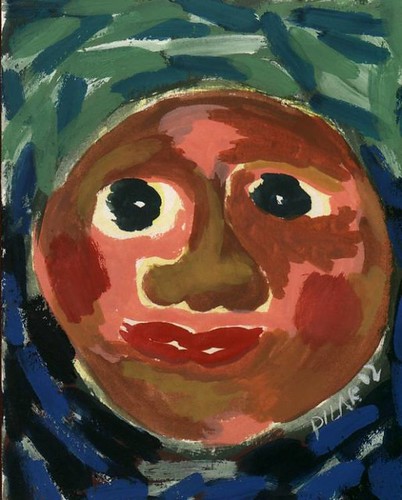
The iguana will bite those who don’t dream, Gouache on paper, 2002
“Your vision will become clear only when you look into your heart. Who looks outside, dreams. Who looks inside, awakens.” (Carl Jung)
I’ve always found refuge in calling myself a dreamer–it takes me places and lights up my eyes, instantly. And other self-hailed dreamers also make for easy (sometimes lasting), instant friends…
Last year, I saw an RCBC billboard that said “Dreams should have a deadline” (read here). Was very moving for me, because it necessarily pushed and snapped me out of the floating comfort zone that was “looking outside”.
When we go inside ourselves and ask the questions that need to be asked, what happens? And what do we lose when we don’t?
A friend pointed me to Daily Routines, a site on “how writers, artists, and other interesting people organize their days.”
Very interesting, not to say inspiring, to get a peek into creative people’s creative processes. What really goes on in the everydays of great artists? It’s creative stalking– being let in on secret lifestyles that follow no real order or structure. I’m reminded of the Blink premise– take 10 minutes to look at a person’s living space and you’ll have a pretty reliable gauge of who or how that person is.. And they do say genius art is not a show of skill as much as it is an extension of the artist’s personality… …